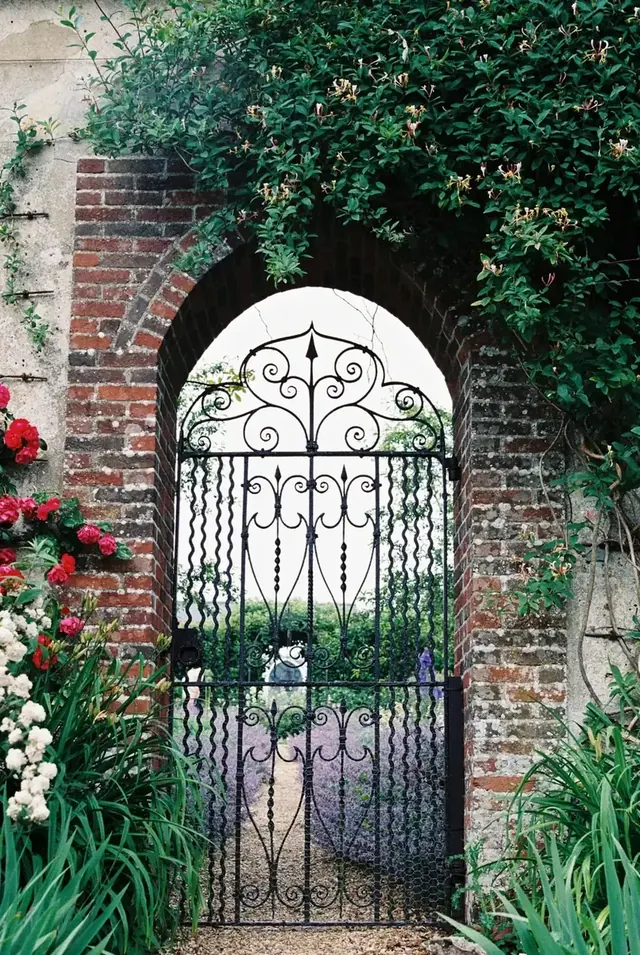
Ornamental Gates in Louisville, KY | Decorative Ironwork Designed for Your Property
Louisville Custom Iron Gates Company designs, fabricates, and installs custom ornamental gates for homes and businesses in Louisville, KY. We will help you plan decorative details, proportions, frame construction, finish, and opening style to fit the property rather than forcing a stock panel into your space. Ornamental gate design can include whatever you like. Anything from scrollwork, finials, and rings to a simpler geometric pattern is on the table. We make sure details match the gate's proportions and the ironwork you have. Hardware and finish choices will complete the design while making sure the gate works for everyday use.
Get a Free Quote on Ornamental Gates
Ornamental Gates in Louisville, KY
Ornamental gate design can use scrollwork, finials, rings, pickets, geometric patterns, arches and decorative infill to change the appearance of an entrance. Those additions still have to work within the structural design of the gate because additional steel and dense infill can increase weight and wind resistance.
Ornamental work is quoted from a drawing. We measure the opening, photograph any ironwork already on the property, then produce a dimensioned elevation before any bar stock is cut.
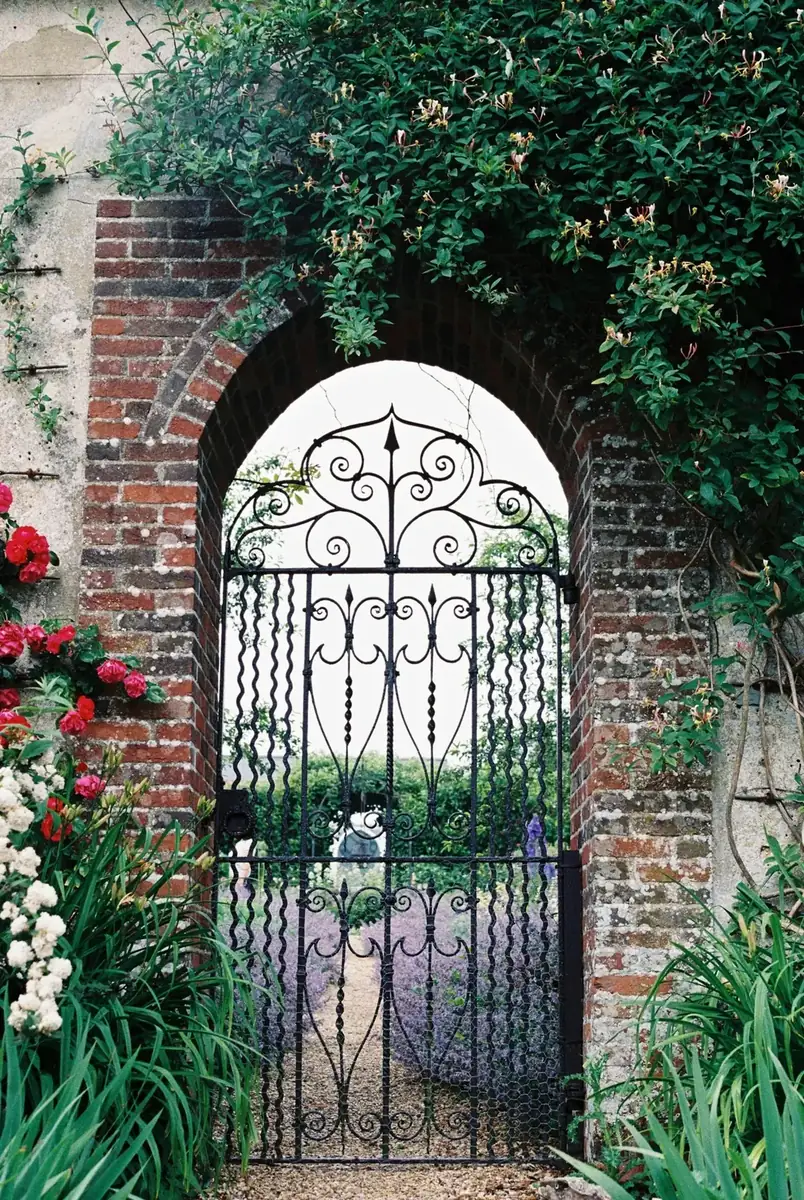
- Hand-formed scrolls in solid bar stock
- Forged collars, rivets or dressed welds
- Drawn to a dimensioned elevation first
Open Ornamental Designs vs. Privacy-Oriented Gates
Widely spaced pickets and open scrollwork preserve visibility through a gate and create less visual mass. Designs with sheet, plate or closely spaced infill provide more screening, but they also create a larger surface for wind to act on. That difference can affect frame, post, hinge and operator requirements on larger gates.
Matching an Ornamental Gate to Existing Architecture
Architectural compatibility is usually more about proportion and repeated shapes than adding as much ornamentation as possible. Arch geometry, vertical spacing, finial shape, rail position and the visual weight of the frame can echo details already present in porch railings, fencing, masonry or the home's facade.
Where Ornamental Detail Meets Structural Reality
Decorative detail is planned alongside structure, not after it. The amount of ornamentation is weighed against gate weight, visibility, wind resistance and the surrounding architecture, so a heavily scrolled design still moves and holds up the way a plainer gate would.
Design decisions are matched to proportion and repeated shapes already present on the property, such as porch railings, fencing or facade details, rather than added simply because more ornamentation is possible.
Our Ornamental Gates Process
Architectural Review
We look at porch railings, fencing, masonry and facade details already on the property to identify shapes and proportions worth echoing.
Ornamental Design
Scrollwork, finials and infill density are balanced against gate weight, wind exposure and how open or private the entrance should feel.
Hand Fabrication
Decorative elements are hand-formed and fitted to the structural frame, not stamped or applied as a surface pattern.
Installation
The finished gate is installed, hardware is adjusted, and the gate is tested through its full range of motion.
Materials, Hand-Forming and Finish on Ornamental Work
Ornamental gates are built in solid bar stock rather than tube wherever the detail will be seen close up, because a scroll formed from solid material holds a crisper line and takes a hammer texture that tube will not. Collars, rivets and forge welds are used where the detail is visible and modern welding is used where it is not, which is the normal way custom ornamental gates have been built for a long time.
Ornament adds weight and, more importantly, adds joints. Every scroll termination is a place where water can sit, so the design accounts for drainage and for access during finishing. Closed sections get sealed or vented rather than left to trap moisture inside.
Finish is where ornamental gates are won or lost. Scrollwork has far more surface area and far more shadowed inside corners than a plain picket gate, so blast preparation and a zinc-rich primer matter more than the topcoat colour. A powder coat covers the profile evenly, but the recesses still need checking before the gate leaves the shop.
Ornamental Gate Styles and Pattern Families
Most custom ornamental gates fall into a handful of recognisable families, and naming the one you are drawn to shortens the design conversation considerably. Scroll and volute work is the traditional wrought iron vocabulary: C-scrolls, S-scrolls and paired volutes arranged symmetrically about a centre line, usually with a heavier scroll at the base and lighter work above. Picket and spear designs stay largely vertical, using finial shape, spacing and the height of the top rail to carry the whole effect. Panel and quatrefoil patterns break the leaf into framed bays with a repeated motif in each. Art Nouveau and naturalistic work uses asymmetric vine, leaf and branch forms that flow across the frame rather than repeating.
Geometric and contemporary patterns are the fourth group and behave differently from the others. Because they are built from straight runs and hard angles rather than curves, they are easier to scale up to a wide driveway leaf without looking stretched, and they read better from a distance than fine scrollwork does.
How Ornamental Detail Is Actually Made
The visible difference between a hand-formed scroll and a bought-in casting comes down to the ends and the surface. A scroll formed hot over a jig tapers as it curls, so the bar gets thinner towards the tip, and it usually carries light hammer texture along its length. A cast or stamped scroll has a constant section and a mould seam, and it will often be tack-welded to the face of the gate rather than let into the frame.
Where scrolls meet, there are three common joins: a forged collar wrapped around both bars, a rivet, or a dressed weld. Collars are the traditional detail and stay visible as part of the design; rivets suit lighter work; a dressed weld disappears entirely, which is sometimes what a contemporary pattern wants. Which one gets used is a design decision, not just a shop preference, and it is worth agreeing at drawing stage.
Finials, rings, baskets and twisted bar are often mixed within one gate. The usual mistake is using too many different motifs at once. A gate that repeats two or three elements at different scales generally reads as designed, while one that uses six reads as a catalogue page.
Scaling a Pattern to the Opening
An ornamental pattern that works at four feet does not simply enlarge to twelve. Scrollwork drawn for a garden gate becomes sparse and thin when the same number of elements is spread across a driveway leaf, so the pattern has to be redrawn with more repeats at a similar physical size rather than the same repeats blown up.
Viewing distance matters as much as opening width. Detail on a courtyard or entry gate is read from a few feet away and rewards fine work; a gate seen from a car at the end of a drive needs stronger, simpler shapes and more contrast between the frame and the infill to register at all.
Where a property has several gates, drawing the pattern once and adapting it to each opening keeps the property coherent. A driveway gate, a pedestrian gate beside it and a side yard gate can share a motif while carrying quite different amounts of detail, which usually looks better than repeating the same busy pattern at three different sizes.
Ornamental Ironwork Across Louisville
Ornamental commissions come mostly from Old Louisville, Clifton and the Highlands, where surviving period ironwork gives us a pattern to work against.
Ornamental Gates FAQs
Is ornamental ironwork harder to maintain than a plain gate?
Slightly, since scrollwork has more surface area and more joints where rust can start. We recommend the same wash-and-inspect routine, just with a closer look at the scroll joints.
Can I see examples of scroll patterns before committing?
Yes, we'll bring sample photos and can sketch a custom pattern based on what you like from our portfolio.
Does ornamental ironwork cost significantly more?
It adds labor time for the hand-forming, so yes, but the increase is usually smaller than people expect once the base gate size and material are already fixed.
Are hand-formed scrolls guaranteed against failure?
Hand-formed work and its joints are covered by our workmanship warranty, and the coating system carries its own terms. We explain both before starting.
Where does your ornamental work usually end up?
Historic neighbourhoods such as Old Louisville and Clifton account for most of it, but ornamental detail suits any property with something worth echoing.
Can you copy an ornamental pattern from an existing gate?
Usually yes. With photographs taken square-on, plus a couple of measurements for scale, a pattern can be redrawn and adapted to your opening. If the original gate is still on the property we will measure it directly.
Get a Free Quote on Ornamental Gates
Call to talk through a pattern, or see the homepage for everything else we fabricate.